
Abstract
This article compares the 1990, 2010, and 2016 American College of Rheumatology fibromyalgia criteria with studies of quantitative sensory testing and the Revised Fibromyalgia Impact Questionnaire. The 1990 criteria combined widespread pain with tenderness at 11 or more of 18 sites; the 2010 criteria replaced that requirement with a combination of painful-site count and symptom severity; and the 2016 revision added generalized pain in four of five regions. This genealogy shows how a prespecified clinical pattern can support a positive judgment without a definitive biomarker. Meeting the criteria, however, does not establish pathophysiologic mechanism, the absence of other conditions, or the patient's whole condition. Quantitative sensory testing records responses to evoked stimuli, while the FIQR records function, overall impact, and symptoms over the previous seven days; neither tool alone determines cause or establishes an individual's diagnosis.
Keywords: fibromyalgia diagnostic criteria · Widespread Pain Index · Symptom Severity Scale · tender points · quantitative sensory testing · FIQR · biomarker
The Question That Arises Before a Test Can Answer
The difficulty surrounding fibromyalgia often begins with the question, “What shows up on the test?” Yet the diagnostic criteria start by asking something else. How widely is pain distributed across the body? How long has it persisted? How severe are fatigue, unrefreshing sleep, and cognitive difficulties? When different generations of the American College of Rheumatology criteria are placed side by side, the diagnostic center of gravity is seen to lie not in a laboratory value but in the definition of a reproducible clinical pattern. [1, 2, 3]
This does not mean that fibromyalgia is “a label applied without doing any tests.” The 2016 revision explicitly states that possible diagnoses and comorbid conditions should be considered through history taking, physical examination, and testing as indicated before the criteria are applied. [3] Examination and testing are needed to look for other causes and coexisting conditions. Their results, however, do not serve as a single biomarker specific to fibromyalgia.
The question therefore needs to be divided into four parts: “What clinical pattern meets fibromyalgia criteria?”, “How does the sensory system respond to an evoked stimulus?”, “How does that pattern affect daily functioning?”, and “What mechanism produced the pattern?” These are not the same question. Diagnostic criteria, quantitative sensory testing, and functional questionnaires can address the first three, respectively, but none resolves the last question on its own. [1, 2, 3, 4, 5]
What Was Compared, and How
This article compares three points in the history of the American College of Rheumatology criteria using the same fields. The original abstract of the 1990 multicenter committee article, the full text of the 2010 preliminary clinical diagnostic criteria, and the full text of the 2016 revisions were examined for intended use, definition of pain, required thresholds, duration, wording about coexisting conditions, and the authors' stated reasons for change. [1, 2, 3] A 2025 scoping review of 126 quantitative sensory testing studies and a 2009 validation study of the Revised Fibromyalgia Impact Questionnaire (FIQR) were then added to examine what diagnosis, evoked sensation, and functional impact each measure. [4, 5] The 2011 self-report modification that followed the 2010 criteria is discussed only to the extent that the 2016 paper explains how the two versions were brought together.
For the 1990 source, the original article's PubMed abstract was available, but the full text was outside the material examined here. Accordingly, this article uses only content stated directly in that abstract, including the sample, criterion wording, sensitivity and specificity, and conclusions about concomitant test abnormalities. [1] Full texts were available for the 2010 and 2016 criteria, the quantitative sensory testing review, and the FIQR study. [2, 3, 4, 5] The different study designs were not pooled as though they yielded a single effect size. Two commentaries on specific mechanistic theories were also left uncited and unsummarized because their original passages could not be verified.
1990: Pain Distribution and 18 Tender Points
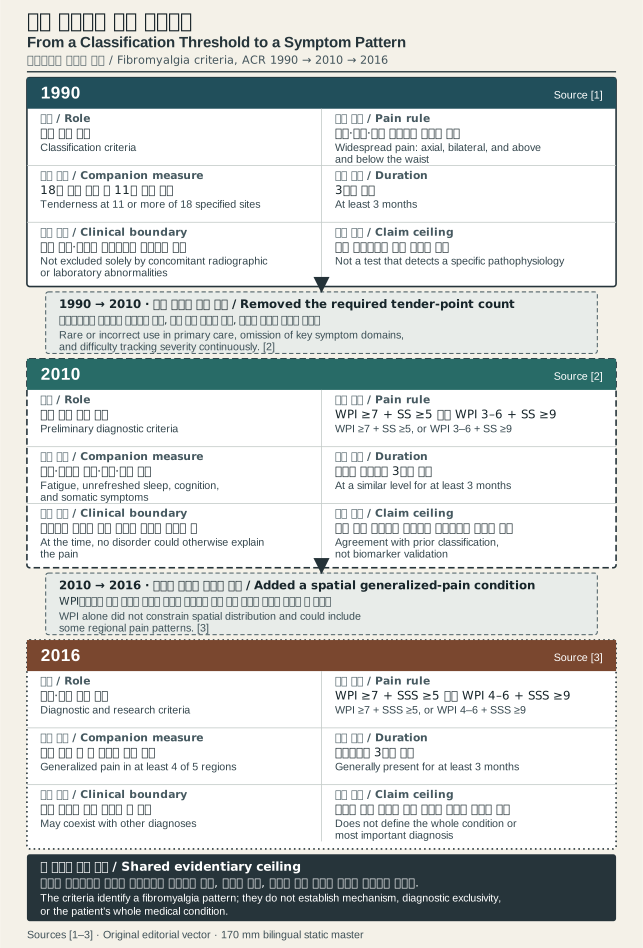
The 1990 multicenter committee studied 293 patients with fibromyalgia and 265 controls, 558 people in all, and proposed research classification criteria. Trained assessors conducted interviews and examinations without knowing whether a participant belonged to the patient or control group. The criteria combined two elements: widespread pain, defined as axial pain, pain on both the left and right sides, and pain above and below the waist; and tenderness at 11 or more of 18 specified sites. [1]
The original article's key phrase was “tenderness at 11 or more of the 18 specific tender point sites.” The criterion did not simply count the places where a person reported pain. It turned tenderness evoked when an examiner pressed designated sites into a binary threshold. When widespread pain and this tender-point criterion were applied together, sensitivity was 88.4% and specificity was 81.1% in the study sample. [1]
Those values do not represent the accuracy of a biomarker. They describe how well the rule distinguished the fibromyalgia group assembled by the investigators from potentially confusable controls. The article itself called the rule “criteria for classification.” The criteria played a major role in creating relatively homogeneous groups for trials and research, but they did not directly detect a particular pathophysiology. [1, 2]
There was another important boundary. The 1990 article did not exclude a person solely because of concomitant radiographic or laboratory abnormalities, and it no longer separated primary fibromyalgia from fibromyalgia concomitant with another rheumatic disorder at the classification level. [1] From the outset, the criteria were not equivalent to an absolute choice between “fibromyalgia” and “another condition.”
Why the Tender-Point Count Was Removed from the Criteria
The 2010 revision did not arise from a declaration that tenderness was unimportant. The first reason given in the paper was feasibility. It noted that tender-point counts were “rarely performed in primary care” and added that, when they were performed, they were often done incorrectly. Some physicians did not know how to conduct the examination, and others did not perform it at all. Diagnosis in routine practice was already largely symptom based. [2]
The second reason was that the criteria needed to capture a broader phenomenon. Fatigue, cognitive symptoms, unrefreshing sleep, and the extent of multiple somatic symptoms, which the 1990 committee had not included, had come to be recognized as important features of fibromyalgia. Some researchers considered that placing tender points too far in the foreground could mistakenly connect the condition to a peripheral muscle abnormality and obscure the broader symptom burden experienced by patients. [2]
The third reason was the difficulty of representing a condition that changes over time. A patient whose symptoms or tender-point count decreased could fall below the 1990 threshold despite a previous fibromyalgia diagnosis. At the time of the 2010 study, about 25% of patients previously diagnosed with fibromyalgia did not currently meet the 1990 classification criteria. The cutoff of 11 was concise for classification, but blunt as a way to record improvement or worsening on a continuum. [2]
For that reason, the shorthand “abolition of tender points” does not capture the whole change. What disappeared was not physical examination itself, but the requirement that a count of 11 out of 18 sites determine the diagnosis. The 2010 authors wrote that every patient still required a physical examination and that tender areas could be examined when appropriate, even though the new criteria did not include a tender-point item. [2]
2010: Asking About the Extent of Pain and the Severity of Symptoms Together
The 2010 multicenter study developed new clinical diagnostic criteria in 829 patients previously diagnosed with fibromyalgia and controls. It used two axes in place of a tender-point count. The Widespread Pain Index (WPI) records, from 0 to 19, the number of body areas that were painful during the previous week. The Symptom Severity scale (SS) records, from 0 to 12, the combined severity of fatigue, unrefreshing sleep, cognitive symptoms, and somatic symptoms in general. [2]
The core rule was as follows: WPI of 7 or higher with SS of 5 or higher, or WPI of 3–6 with SS of 9 or higher. Symptoms had to persist at a similar level for at least three months, and this edition required that no disorder otherwise explain the pain. [2] The structure allowed a moderate symptom burden when pain involved very many areas, but required a high symptom burden when the number of painful areas was lower.
The rule classified 88.1% of cases classified by the 1990 criteria in the same category and did not require a physical examination or tender-point examination as criterion items. [2] But 88.1% is not agreement with a biological truth. The 2010 article acknowledged that fibromyalgia lacked objective physical or laboratory features and well-characterized pathological findings, and that no independent standard case definition was available for developing the criteria. The new rule was an empirical case definition based on the existing classification criteria and clinicians' judgments.
Even so, the change did not turn diagnosis into a residue left after exclusion. It required observable components, WPI and SS, together with explicit thresholds and duration. Negative findings on tests for other conditions are not enough to satisfy the criteria. The specified distribution of pain and symptom burden must be positively identified. [2]
Whether a diagnosis is present must also be distinguished from measuring its impact after diagnosis. The FIQR records 21 items across three domains—function, overall impact, and symptoms—over the previous seven days. Memory, tenderness, balance, and environmental sensitivity are included in the symptom domain. [5] The questionnaire structures the burden on daily life, but it neither replaces the fibromyalgia criteria nor determines cause.
In the 2009 validation study, 202 participants with fibromyalgia completed the FIQR online, and its three domains correlated with the corresponding domains of the earlier FIQ at coefficients of 0.69–0.88. [5] A focus group of 10 women patients contributed to item development by revising wording and content. This is one instance in which patient perspectives changed the measurement tool itself. The study, however, did not directly assess online test–retest reliability, included only 12 men, and did not estimate sensitivity to change or a minimal clinically important difference. [5] This single study should not be extended into a statement about the priorities of all patients or a fully validated measure of severity in every respect.
2016: Defining “Widespread Pain” More Precisely Again
As the 2010 and 2011 criteria were used in research and practice, a new problem appeared. The WPI counts painful sites but does not directly restrict how they are distributed across the body. Some localized or regional pain syndromes could therefore be classified as fibromyalgia when combined with a high symptom score. To address this problem, the 2016 revision added a “generalized pain” condition different from the 1990 definition. [3]
The 2016 formula is WPI of 7 or higher with Symptom Severity Scale (SSS) of 5 or higher, or WPI of 4–6 with SSS of 9 or higher. In addition, pain must be present in at least four of five regions: left upper, right upper, left lower, right lower, and axial. Jaw, chest, and abdominal pain count toward the WPI but are excluded when the generalized-pain condition is calculated. Symptoms must generally have been present for at least three months. [3]
Raising the minimum of the lower WPI range from 3 to 4 was not a separate arbitrary adjustment. Requiring pain in four regions makes a WPI of at least 4 necessary. The authors reported that this condition reduced misclassification of regional pain while making only a very small change to the existing 2010/2011 case definition. In the analyzed data, 0.4% of cases were reclassified by the condition. [3]
The 2016 edition also changed the wording of the exclusion condition. The original phrase “valid irrespective of other diagnoses” means that a fibromyalgia diagnosis remains valid regardless of other diagnoses. The paper then explicitly states that a fibromyalgia diagnosis does not exclude the presence of other clinically important illnesses. [3] This does not mean that differential diagnosis is unnecessary. It means that the presence of another condition should not erase a pattern that meets fibromyalgia criteria.
What the Criteria Establish Positively
The absence of a definitive biomarker does not mean that a positive diagnosis is impossible. Here, “positive” does not mean a positive result on a particular test. It means determining whether a prespecified combination is present: the extent of pain, the severity of core symptoms, duration, and, in the 2016 edition, spatial distribution. Because a defined pattern must be present, this differs from making a diagnosis solely because other tests were negative. A self-scored threshold alone, however, must not be used to establish an individual's diagnosis. The 2016 article distinguishes physician-applied criteria, which are valid for individual diagnosis when used with medical evaluation, from the self-report version, which is intended for research and is not valid for an individual's clinical diagnosis. [2, 3]
The generational changes in the criteria reinforce this point. The 1990 criteria combined widespread pain with examiner-confirmed tenderness; the 2010 criteria combined the number of painful sites with the severity of several symptom domains; and the 2016 criteria again required spatial generalization. No edition defines fibromyalgia through a single symptom or through a “failure to find a cause” alone. [1, 2, 3]
WPI and SS/SSS record, within specified items and score ranges, the number of body areas painful during the previous week and symptoms such as fatigue, unrefreshing sleep, and cognitive difficulties. Applying these items with prespecified thresholds and duration makes it possible to judge whether the reported symptom pattern fits the criteria. This is not evidence that creates the pain; it is the organization of reported experience into the form addressed by the criteria. [2, 3]
Quantitative sensory testing observes another layer. It applies controlled mechanical or thermal stimuli and measures the responses, so its values are not the same as the WPI's count of painful sites during the previous week or the FIQR's account of daily impact. [2, 4, 5] The 2025 scoping review examined 126 studies using static and dynamic tests but reported that no protocol was followed consistently and that testing sites and types of tests varied. [4]
This heterogeneity does not make quantitative sensory testing worthless. It does limit comparisons across studies and application to an individual's diagnosis. The review authors also noted that inconsistency in testing sites and stimulus conditions may reduce its reliability as a biomarker for fibromyalgia. [4] A difference in evoked response is therefore an observation that can be studied, but it is not in itself a test that establishes fibromyalgia or judges whether a patient's reported pain is genuine.
What the Criteria Do Not Establish
First, meeting the criteria does not establish cause. WPI and SSS do not measure why pain arose or determine which of central sensitization, immune change, or autonomic change produced an individual's symptoms. The 1990 tender-point examination was not a test proving a particular peripheral muscle pathology either. [1, 2, 3] Quantitative sensory testing does not simply fill this gap. The 2025 review noted that temporal summation and conditioned pain modulation are often used as measures of central sensitization, but that the peripheral nervous system also participates, so the parameters used to analyze sensitization need to be defined in each study. [4] The validity of diagnostic criteria, the nature of evoked sensory responses, and the validity of a mechanistic hypothesis are distinct research questions.
Second, meeting the criteria does not establish that no other condition is present. The 2016 wording specifically allows fibromyalgia and another clinically important condition to coexist. For a person being assessed for a new diagnosis, history, examination, and tests suited to the situation remain necessary to evaluate alternative explanations and comorbid conditions. Conversely, finding another condition or an abnormal test result should not automatically cancel a pattern that meets fibromyalgia criteria. [3]
Third, meeting the criteria does not summarize the whole of a patient's condition. The 2016 authors drew a clear boundary: satisfying the criteria cannot define the entirety of a person's medical status. [3] That is why tools such as the FIQR, which separately records function, overall impact, and symptoms, are needed. [5] Yet the FIQR structures self-report over the previous seven days; it is not a complete record of within-day variation, treatment response, comorbid conditions, or life context. Criteria and questionnaires are not the endpoint of care but a shared language with which more specific observation can begin.
The genealogy of the three editions and the two measurement studies leaves a restrained but clear conclusion. Fibromyalgia can be identified through an explicit symptom pattern without a single biomarker. Quantitative sensory testing and functional questionnaires do not replace that judgment as final tests; they observe evoked sensory responses and effects on daily life in greater detail. But this judgment alone does not guarantee a final pathophysiologic explanation or the absence of another condition. The next research question should not be “Is the pain real?” but “How can standardized sensory measures, functional indicators, and observation over time distinguish different trajectories among people who meet the same criteria?” [1, 2, 3, 4, 5]
Declarations
- Author contributions (CRediT)
- Baekrokdam Research Commons (BRC): Investigation, Data curation, Evidence verification, Writing – original draft, Writing – review & editing
- Data availability
- This article used only the public literature listed in its references. No individual patient data or separate clinical dataset was used.
- Funding
- No external funding.
- Competing interests
- The publishing organization originated at Baekrokdam Korean Medicine Clinic and has clinical and commercial interests. This article is not evidence for a particular diagnosis or treatment effect.
- AI use disclosure
- AI tools assisted the structuring of public-literature materials, drafting, and bilingual production. AI is not an author; BRC remains responsible for source verification, final judgments, and publication.
- Ethics
- Only public literature was used; no individual patient data or clinical intervention was involved. Any future human-participant research requires separate ethics review before it begins.
References
- Wolfe F, Smythe HA, Yunus MB, Bennett RM, Bombardier C, Goldenberg DL, et al. The American College of Rheumatology 1990 Criteria for the Classification of Fibromyalgia: Report of the Multicenter Criteria Committee. Arthritis & Rheumatism. 1990;33(2):160–172. PMID:2306288. Source
- Wolfe F, Clauw DJ, Fitzcharles M-A, Goldenberg DL, Katz RS, Mease P, et al. The American College of Rheumatology Preliminary Diagnostic Criteria for Fibromyalgia and Measurement of Symptom Severity. Arthritis Care & Research. 2010;62(5):600–610. doi:10.1002/acr.20140. https://doi.org/10.1002/acr.20140
- Wolfe F, Clauw DJ, Fitzcharles M-A, Goldenberg DL, Häuser W, Katz RL, et al. 2016 Revisions to the 2010/2011 Fibromyalgia Diagnostic Criteria. Seminars in Arthritis and Rheumatism. 2016;46(3):319–329. doi:10.1016/j.semarthrit.2016.08.012. https://doi.org/10.1016/j.semarthrit.2016.08.012
- Carneiro AM, de Góes Salvetti M, Dale CS, da Silva VA. Quantitative Sensory Testing in Fibromyalgia Syndrome: A Scoping Review. Biomedicines. 2025;13(4):988. doi:10.3390/biomedicines13040988. https://doi.org/10.3390/biomedicines13040988
- Bennett RM, Friend R, Jones KD, Ward R, Han BK, Ross RL. The Revised Fibromyalgia Impact Questionnaire (FIQR): Validation and Psychometric Properties. Arthritis Research & Therapy. 2009;11(4):R120. doi:10.1186/ar2783. https://doi.org/10.1186/ar2783